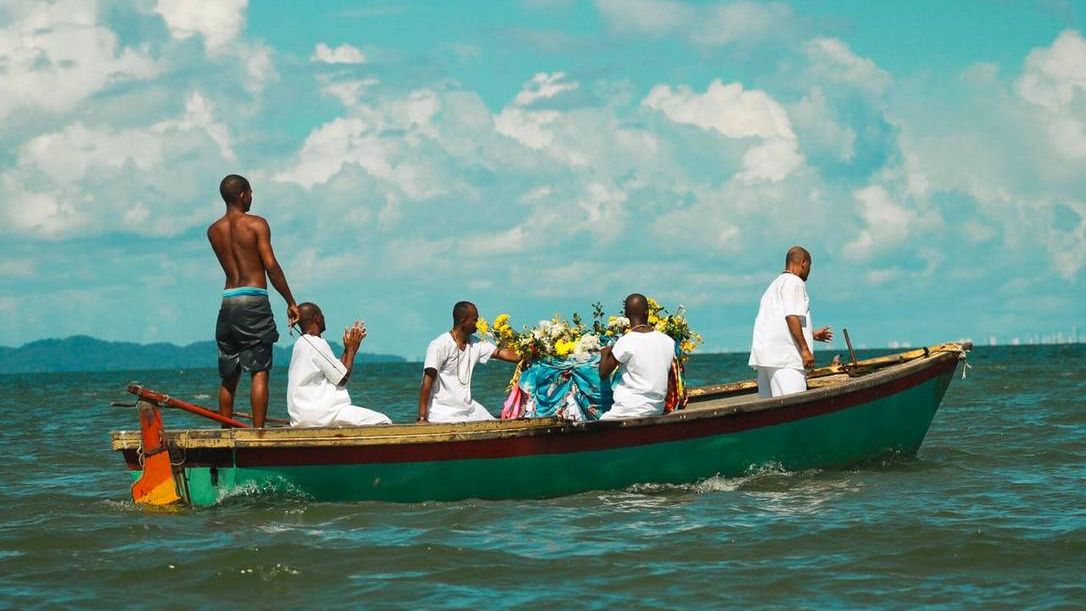
Party takes place from May 13th to 15th, with itineraries departing from Salvador (BA)
May 13th is one of the most controversial dates for black people in Brazil.
The Golden Law, signed by Princess Isabel, had only one line and did not guarantee rights for black people who were being freed, nor did it free Brazilian society from its slaveholding mindset. Even with this inconclusive abolition, on May 13, 1888, many black people allowed themselves to celebrate the long-awaited freedom, singing and dancing through the streets, squares, and slave quarters throughout the Country. From 1889, in Santo Amaro, Bahia (always there), black people return every year on this day to occupy Market Square, holding the Bembé do Mercado, which is considered the largest African matrix religious festival in public space.
According to oral history, passed down to this day, it was João Obá, a freed African of Malê origin, who first occupied the central streets with drums, flowers, fruits under a straw shack where they danced and sang in reverence to the orixás for three consecutive days - before a large collective offering was made to the sea as a thanksgiving to the goddesses.
Since then, in the same place, Largo do Xéreu, a large candomblé is formed every year to bring together children of saints from almost 100 different religious houses in the region, as well as black people and their descendants from various cities in the Bahian Recôncavo, Brazil, and the world - in addition to all those who revere the matrix culture and freedom.
With capoeira circles, samba, popular enactments, and lots of food, the event quickly became a celebration of life and abundance, dedicated especially to the water deities, such as Yemanja and Oxum, also a moment to thank for individual and collective protection.
The repercussion was such that throughout post-abolition Bahia, people talked about the Festa de Preto or the Candomblé da Liberdade, the names the party had before popularizing as Bembé do Mercado. Even today, it is considered the largest street candomblé in the world. In 2019, the celebration was recognized as Cultural Heritage of Brazil.
Now, imagine what it represented, in 1889, the occupation of the municipal market square by black people and drums. At that time, the iconic city of Santo Amaro was a sugar and food hub, led by a white and Catholic lordly elite, with a social structure marked by slavery. Until then, the cultural manifestations and religious practices of black people were not freely accepted even within the terreiros. They only happened with official authorization, or as was more common, associated with Catholic manifestations - the so-called syncretism.
However, on May 13, the market square was occupied without permission or prior notice by the drums, the saint's clothes, and the chorus of João de Obá's children. The market was a place of great flow of freed blacks and meeting point with enslaved people, who sold goods produced under the colonial regime.
The occupation of that space with the party is read, by historiography, as a political act, with the market being the main protagonist of the party. In the religious aspect, Bembé is characterized as an obligation destined for water deities. All traditional candomblé rites are performed in specific ceremonies over the three days of the party: First, the Padê de Exu and the Orô de Yemanja and Oxum. On the second day, the Xirê is performed in the Market Square, and, finally, the offering of offerings to Mãe d'Água.
The celebration involves over 100 religious communities in the region, but is currently led by the Beneficent and Cultural Association Ilê Axé Qjú Onirè, and the priest Father Pote. It was he who requested recognition of the party as a heritage in all spheres and political authorities, since 2012.
Despite its religious nature, the party has always mobilized different sectors of the city, from traders and fishermen to political activists. As a cultural manifestation, it has reinvented itself over the years and incorporated different popular, traditional, and folkloric languages. Among them, Maculelê, Nego Fugido, female processions, samba and capoeira circles, among other manifestations of popular culture and the African diaspora.
👉🏾 Want to experience the Bembé do Mercado 2026 up close?
Diaspora.Black has prepared a special 6-day immersion during the Bembé do Mercado 2026. Between Santo Amaro and Cachoeira, in the Bahian Recôncavo, you will experience a pilgrimage to the territories where samba was born, where freedom was conquered, and where ancestry is celebrated in the open air.
See the complete itinerary of Bembé do Mercado 2026 here.
04/26/2023